Nigerian men's vitality researcher who has quietly guided over 400 African men out of this exact problem finally speaks openly:
"STOP TAKING SUPPLEMENTS THAT ONLY WORK FOR THREE DAYS — YOUR BODY IS NOT THE PROBLEM!"
At Last! The 30-Day Natural System That Restores Your Full Stamina, Energy and Bedroom Confidence — Without Prescriptions, Without Agbo, and Without Ever Explaining Yourself to Anybody
👉🏾 YES — SHOW ME THE SYSTEM THAT ACTUALLY FIXES THISClick Here to Get Instant Access — ₦9,900 · Instant Download

Week three I woke up and something was different. Not dramatically — but something in my body had come back. Something I had stopped noticing the absence of. By week four my wife said I seemed like a different man. She had no idea what I had been doing. I had not told her anything. That alone told me everything I needed to know about whether this works.
Dear Brother,
Let us be very honest with each other for a moment.
How many times have you told her you were tired?
Not because you were tired. Because you already knew what would happen if you tried.
So you found a reason. You stayed up late. You said work was heavy. You waited until she slept.
And when she finally stopped reaching for you — you told yourself that was better.
But it was not better.
- You have bought supplements from three different pharmacies
- You have finished bottles of herbal capsules that somebody strongly recommended
- You have taken agbo that a man in your office swore by like it was gospel
Something works small. For a few days. Then your body goes back to exactly where it was.
And the most painful part is not even what happens in that room.
It is that quiet voice that comes at night when the house is silent:
If you know that voice — if that voice has been living inside you for months — take a deep breath and read every single word on this page.
But before we continue, I need to tell you something that will shock you.
The reason nothing you have tried has worked has almost nothing to do with your body being broken.
- It has nothing to do with your age
- It has nothing to do with you not being man enough
- It definitely does not mean this is permanent
You have not been failing because your body has given up.
You have been failing because you have been treating one thing in a body where four things are wrong at the same time.
Every product you bought was designed to address one single factor. But your performance in that room is not controlled by one factor.
When you attack one part of a system that is broken in four places, it will fail every single time. No matter how expensive the product is.
You see, your body is not failing you. Your body is reporting to you.
You are not a weak man. In fact, you are probably one of the most hardworking, responsible men in your circle.
- You wake up early. You handle pressure that would break other men.
- You provide. You show up. You carry people.
And that is exactly the problem.
Because the same body that has been absorbing Lagos traffic, work pressure, four hours of sleep, skipped meals and constant stress for years — is the same body you expect to perform perfectly at 10pm.
Your blood circulation has been under pressure for years.
Your stress hormones have been elevated for years — and elevated stress hormones directly suppress what a man needs.
Your sleep has been broken for years.
Your food has been feeding inflammation instead of blood flow.
And now, after all of that, your body is finally sending you the report. It sends that report in one place. The bedroom.
This is not an age problem. This is a system problem. And a system problem can be reversed.
Here's what's actually going on.
People will tell you to just "manage it" or "reduce stress." But telling a Nigerian man to reduce stress is like telling him to stop breathing. That is not a solution. That is an insult.
The truth is: your bedroom performance is the last place your body sends its report card — not the first place the problem starts.
Circulation. Stress hormones. Sleep quality. Nutrition. And the mental cycle that now starts before anything even begins. When one is off, your body compensates. When two are off, it struggles. When three or four are off at the same time — which is the exact situation of almost every Nigerian man over 35 — the report lands in that room.
- You don't need another supplement
- You don't need another herbal mixture
- You don't need to accept that this is just who you are now
You need a system that fixes all of it together, in the right order, over enough time for your body to actually recover.
That is exactly what The Iron Man Protocol was built to do.
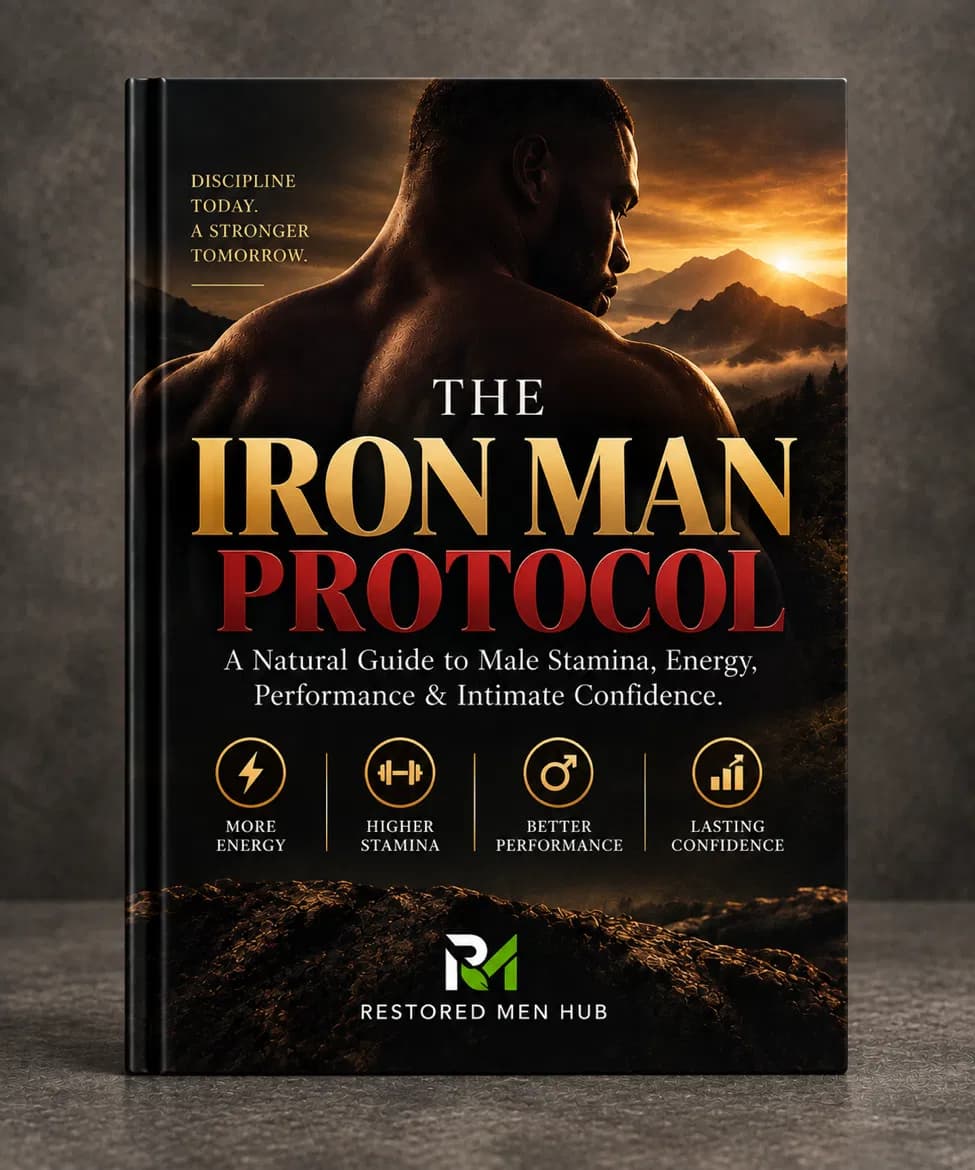 👉🏾 SEND ME THE IRON MAN PROTOCOL NOW — ₦9,900
₦9,900 · Instant Download
Let me be completely upfront with you:
❌ This is not another "natural remedy" ebook.
If you are looking for a list of herbs and a promise that one root will change your life overnight, close this page. There are hundreds of those on WhatsApp and they have already failed you.
The Iron Man Protocol is a practical, day-by-day execution system. It shows you exactly how to reverse the four things that have been quietly working against your body — and gives you a thirty-day structure so you actually do it instead of just reading it.
It takes everything your body needs and gives it a structure — so the results do not disappear after three days like every product you have bought before.
Here is the exact reason this works when nothing else has.
Every product you have tried starts with the symptom. They tell you: take this, drink that, use this herb before bed.
When you attack the symptom without restoring the systems underneath it, whatever small result you get will collapse the moment your body goes back to normal life. Because the foundation is still broken.
Buying a single-ingredient solution for a four-system problem is like changing one tyre when the engine, the fuel and the alignment are all finished. The Iron Man Protocol fixes all of it.
Circulation. Hormones. Recovery. Nutrition. Mindset. From that foundation, the stamina, the energy and the confidence stop being something you hope for — and start being something your body simply does again.
Let Me Show You What This Looks Like In Real Life
Imagine three weeks from tonight...
It is around 10pm. The house is quiet. She moves closer.
And for the first time in a long time — you are not calculating.
No excuse forming in your head. No scanning for an exit. No dread sitting in your chest. You are just there. Present. Ready. The way you used to be before all of this started.
- Your body responds the way it is supposed to
- Your energy is actually there
- Afterwards, you are not lying in the dark replaying anything
And in the morning, you do not have to overcompensate. You do not have to be extra attentive to apologize for something nobody said out loud. You just wake up like a man who has nothing to apologize for.
And here is the part that will really move you.
Around week three, she will notice before you say a single word. Not because you announced anything. Because it is impossible to hide.
- The way you carry yourself changes
- The way you look at her changes
- The quiet distance that has been growing between you starts to close on its own
That is not just a bedroom change. That is your marriage getting its confidence back.
👉🏾 YES — I WANT THAT VERSION OF MY LIFE. GIVE ME ACCESS.₦9,900 · Instant Download
Here is exactly what is waiting for you inside:
The Male Vitality Foundation
The chapter that finally explains — in plain language — exactly what is happening inside your body. How circulation connects to performance. How chronic stress measurably suppresses what a man needs. Why sleep is not optional for this specific area of your life. The knowledge that ends the guessing permanently.
Eat Like You Expect Your Body to Perform
Not "eat healthy" advice. The specific foods that feed the systems that matter — using food you can buy at any Nigerian market this weekend. No imported supplements. No strange diet. Plus the everyday habits quietly working against you, named clearly so you can remove them today.
The Natural Performance Toolkit
THE TRUTH ABOUT HERBS AND SUPPLEMENTS: Which ones research actually supports, which ones are pure marketing, and which ones you should stop taking immediately. This module alone will save you more than the price of this entire guide.
Build Your Performance Engine
The specific exercise almost no men's guide in Africa mentions — that directly builds stamina and control, takes less than five minutes a day. Plus practical movement that fits a working man's life. No gym required.
Energy Is Part of Performance
The Devastating Reason Sleep Is Destroying Your Performance: What is happening to your hormones between 11pm and 3am — and the simple change that reverses it. The chapter most men skip and should not.
The Confidence Advantage
The 4-Minute Reset: What to do in the moment when you feel the pressure rising and your mind starting to work against you. Works in under 300 seconds. Plus: the sneaky way your own mind manufactures the exact outcome you are dreading — and the single principle that breaks this cycle permanently.
Intimate Performance
Where every module comes together. Stamina, pacing, arousal awareness, confidence, communication, and the habits outside the bedroom that pay directly into what happens inside it. No unrealistic promises. Just a grounded, practical system for performing at your best — consistently, not occasionally.
The Complete Iron Man Protocol + Tracker + Cheat Sheet
Week 1: Reset. Week 2: Build. Week 3: Optimize. Week 4: Own It. A daily checklist for every single day so you always know exactly what to do. Plus a 30-day tracker to follow your progress and a quick-reference cheat sheet — everything on one page, on your phone, beside your bed.
When To See A Doctor
The specific symptoms that mean this is not a lifestyle issue. I will tell you honestly, because your health matters more than this sale.
Real Men. Real Results.
What men across Africa are saying about The Iron Man Protocol 👇🏽
"I finished the guide three weeks ago. I won't write everything but I will say this — my wife cooked jollof last Sunday and was playing music in the house. She hasn't done that in months. I know what changed. Emmanuel God bless you for putting this together. This is not another PDF. This is the actual answer."
"Ghanaian man here. I saw this shared in a group and was very skeptical. Bought it anyway because I had spent so much on other things. Week 3 was when I noticed — my energy in the morning first, then everything else followed. This guide addresses the actual cause not the symptoms. Nothing else I tried understood that."
"The sleep and recovery module changed my understanding completely. I didn't know what was happening while I was sleeping was directly working against me. I implemented just that module first and noticed a shift by day 8. The full 30-day protocol after that is something else entirely. I am genuinely a different man."
"I work in healthcare and I will say this plainly — the information in this guide is accurate and well-researched. The section on stress hormones and their direct connection to male vitality is clinically correct. What I appreciate is that it is presented in a way any man can understand and act on. Not every man will go to a specialist. This guide is the next best thing."
"I'm 44. I had convinced myself it was age. This guide showed me I was completely wrong. The food section showed me things I was eating every single day that were quietly working against me. Changed those things, followed the 30-day plan, and the improvement is real. Not a flash that disappears. Real and steady. My wife noticed by week three."
Now Let's Talk About What This Is Worth
Think about what one more year of this actually costs you. Not just money — though that is real too.
How much have you already spent on supplements, capsules, agbo and "special" products that gave you three days of hope and then nothing? Add it up honestly. Most men reach ₦60,000 to ₦150,000 before they stop counting.
But more than money — think about what it costs you at home. Every month this continues is another month of distance you cannot get back. Another month of her slowly stopping asking. Another month of you managing instead of living.
If you saw a specialist about this, you would be looking at ₦80,000 to ₦250,000 for consultations — and most men in this country will never walk into that office because of shame alone.
But you are not paying anywhere close to that today.
I want this in the hands of as many African men as possible. Especially men who have been carrying this quietly and never had anybody explain the truth to them. So the full Iron Man Protocol — all four guides — is just:
🔥 AND THAT'S NOT ALL — YOU'RE ALSO GETTING 3 FREE BONUSES
Because I do not want you to have only half of what you need.

BONUS #1 — The Attraction & Confidence Playbook
How to feel confident, attractive and in control before intimacy even begins
- Building real masculine confidence
- Grooming and presentation that changes how she looks at you
- Overcoming insecurity that has been quietly growing
- Creating an intimate atmosphere that removes pressure
- Communication that brings her closer instead of creating distance
The man who walks in already feeling like himself has won half the battle before anything begins.
Value: ₦9,000 — Yours FREE Today
BONUS #2 — The 7-Day Vitality Meal Plan
Stop asking "so what exactly do I eat?"
- Breakfast, lunch, dinner and snacks — all seven days
- Built entirely around foods from your local market
- Nothing expensive, nothing imported, nothing strange
- Full shopping list included
- Substitutions so you are never stuck
Some men will buy this whole package just for this bonus. It removes every excuse about not knowing what to eat.
Value: ₦7,500 — Yours FREE Today
BONUS #3 — The Natural Performance Encyclopedia
Never waste money on the wrong product again
- Every herb, root, nutrient and supplement — examined honestly
- What research has actually explored for each one
- Where evidence is genuine vs. where it is marketing
- Safety considerations you need to know
Next time somebody in a WhatsApp group swears by something, you will know within thirty seconds whether it is worth your money.
Value: ₦12,000 — Yours FREE Today
📦 YOUR COMPLETE PACKAGE
Instant Download
Instant digital download · Works on any phone, tablet or computer
More Men. More Results.
👇🏽 Continuing testimonials from buyers
Bros I want to be very honest. I thought this would be another supplement recommendation in disguise. It is not. There is a whole chapter that explains WHY supplements alone never work. And the reason it gives is the exact same reason none of the things I tried for 14 months ever worked. Once you understand that, everything makes sense. Finished the 30 days. The results are real and they are staying.
My relationship was in serious trouble because of this problem. My wife was patient but I could see her patience changing shape. I ordered this, followed it quietly for 30 days, and by week 3 she called her mother to say something good had changed at home. She did not know what I had been doing. I had not told her anything. I am telling every man I trust about this guide.
The Natural Performance Encyclopedia bonus changed how I make every health decision. I used to walk into stores and buy whatever somebody recommended. Now I understand exactly what I am buying and why. That knowledge is permanent — it will save me far more money than this guide cost. And the protocol itself — my wife's reaction by week three told me everything I needed to know.
Read this guide in one night. Started the protocol the next morning. I am in week 2 now and already feeling something I haven't felt in years. I don't want to give a full testimony until I complete the 30 days but what I can say right now is that the food section alone has reorganized everything I eat. Day 11 was when I noticed the first real shift. This is not a small thing.
Real messages from men on the protocol
— swipe to read each story 👆
👆 Tap arrows or swipe to read each conversation
Putting this together — the research, the writing, the 30-day system, the design — cost over ₦180,000.
- ✦ Research, fact-checking and source review ₦45,000
- ✦ Professional writing and editing ₦55,000
- ✦ Content accuracy review ₦35,000
- ✦ Layout, design and formatting ₦28,000
- ✦ Platform setup and delivery ₦17,000
I am not charging you ₦180,000. Not ₦50,000. Not ₦20,000.
A fair price for everything inside — the guide and all three bonuses — would be:
₦43,500That is less than what you have already wasted on things that did not work. And it could change what happens in your home for the rest of your life.
Instant digital download · In your hands within 2 minutes of payment
My 30-Day "Feel The Difference or Full Refund" Guarantee
Read the guide. Follow the 30-day protocol consistently. Apply what is inside for the full thirty days. If after all of that you genuinely feel no real, undeniable difference in your energy, your stamina and your confidence — simply send one email. We will make it right, no lengthy back and forth.
No uncomfortable questions. No delays. Your purchase is protected.
Either this changes what happens in that room — or it costs you nothing.
👉🏾 ZERO RISK. START MY 30-DAY RESET TONIGHT — ₦9,900Instant delivery · Completely private & discreet
Questions People Ask Before Buying
Everything you need to know before you get started
One Last Thing Before You Decide
Let me be straight with you. You did not land on this page by accident. If you have read this far, it is because something on this page described your exact life. You recognised yourself somewhere between the excuses and the voice at night.
But I know exactly what happens next. You have been at this crossroads before. You get clarity, then you close the tab. You tell yourself "next month" or "let me think about it" — and next month never comes.
Do not let today be another one of those days.
Not because I am pressuring you. I want you to act because you are tired — and you already know it.
- You are tired of finding a new excuse every week
- You are tired of buying products that work for three days
- You are tired of watching the woman you love slowly stop reaching for you
For less than what you spend on data in a month, you can start fixing the actual cause tonight. The man who does not have to explain himself at 10pm is not far away. That man is one decision away. Make it today.
I had spent close to ₦90,000 on supplements, herbs and everything else in one year. None of it lasted more than a week. This guide cost me ₦9,900 and inside Module 1 I finally understood why everything else had failed. I was treating a symptom. Not the problem. Once you understand that, you cannot unsee it. Thirty days later I am a different man at home.
Instant digital download · Works on phone, tablet or computer · In your hands in 2 minutes
Two versions of the next thirty days.
You follow the system. By day eleven something shifts. By week three the woman you love looks at you the way you have been missing. The excuses stop. Not because you forced them to. Because you no longer need them. You become the man you have been pretending to be.
You go back to the pharmacy supplements. The herbal capsules. The late-night searches. The quiet avoidance that has been growing its own kind of distance in your relationship. The problem does not fix itself. You know this already. Every day you wait is another night of the same.
₦9,900 · Instant delivery · Completely private & discreet
About Emmanuel
Emmanuel is a men's vitality researcher who has quietly guided over 400 African men out of this exact problem. He specializes in natural, practical systems for male performance and has spent years translating complex physiology research into language and daily plans that working African men can actually use. He does not sell supplements. He builds systems.
You do not have to live with this for another twelve months.
One last thing before you go...
I want to be honest with you.
I did not build this to get rich. If that was the plan, I would have priced it at ₦50,000 and moved on. I built it because I know exactly what it feels like to be the man you are right now. The one who handles everything in life — work, family, responsibilities — but cannot handle this one private thing. The one who replays difficult nights for three days in silence. The one whose partner is patient but quietly running out of understanding of what is actually going on.
I was that man. For almost two years, I was him.
When I finally understood what was actually wrong — and fixed it — the first thing I felt was frustration that nobody had explained this to me sooner. Not a doctor. Not the internet. Nobody.
This guide is what I wish had existed then.
If it does for you what it did for me, ₦9,900 will be the most important money you spend this year.
— Emmanuel
PS: Think honestly about the true cost of one more year of this. Think about the distance in your marriage that grows every month this continues. Think about the confidence you have lost in yourself that has started showing up in other areas of your life — how you speak, how you carry yourself, how you show up at work. This is not just a bedroom issue anymore and you know it.
PPS: The woman you love is patient. But patience is not the same as peace. Every man who has been through this knows there is a version of his relationship being quietly held together by her patience alone — while the real distance grows underneath. That patience is precious. Do not spend another month of it. Give her the man she married back. Start tonight.
PPPS: Think about where you will be thirty days from now if you start today. Same house. Same woman. Same bedroom. But a completely different version of what happens inside it — and what happens inside you. The version of yourself you have been trying to get back to is not gone. He is waiting on the other side of thirty days of the right system. The man you are as you read this and the man you will be thirty days from now are separated by one decision. This is that decision.
👉🏾 THIS IS MY DECISION. GIVE ME INSTANT ACCESS NOW — ₦9,900Click Here Before You Close This Tab And Go Back To The Same Cycle